The Truth Store II
Monday, June 10, 2013
The Rothschild Family - Puppet Masters - World's Only Trillionaires - Fu...
Wednesday, March 23, 2011
Should the corporate United States and the State of Pennsylvania be dissolved?
(14) ``State'' means any of the several States, the District of Columbia, the Commonwealth of Puerto Rico, the Commonwealth of the Northern Marianas, or any territory or possession of the United States.
(15) ``United States'' means--
(A) a Federal corporation;
(B) an agency, department, commission, board, or other entity of the United States; or
(C) an instrumentality of the United States.

From Dissolution in PA —The Death Of A Pennsylvania Business Corporation:
. . . a shareholder or director may petition the court of common pleas to order the winding up and involuntary dissolution of the corporation if and only if one of the following is established:
The acts of the directors, or those in control of the corporation are illegal, oppressive or fraudulent and that it is beneficial to the interests of the shareholders that the corporation be wound up and dissolved;
The corporate assets are being misapplied or wasted, and it is beneficial to the interests of the shareholders that the corporation be wound up and dissolved; or
The directors are deadlocked in the direction of the management of the business and affairs of the corporation and the shareholders are unable to break the deadlock, such that irreparable injury to the corporation is being suffered or is threatened as a result.
In the absence of illegal or fraudulent activity, a misappropriation of assets to the detriment of one or more shareholders, or irreconcilable differences amongst the board of directors, the corporation’s unhappy shareholders may have no recourse but to suffer the perceived mismanagement or sell their stock, often at a tremendous loss.
Sunday, April 18, 2010
ARTICLES OF FREEDOM
Wednesday, October 28, 2009
On "Immunity"
Tuesday, October 06, 2009
MAKE MINE FREEDOM (1948)
Thursday, October 01, 2009
CONTINENTAL CONGRESS ELECTIONS WERE OCTOBER 10th 2009
The Continental Congress will convene on November 8, 2009.
Tuesday, September 01, 2009
Congress requires our oversight.
So: What's the next step for a free people?
- Reaffirm your allegiance to the organic principles of our constitutional republic.
- Become involved in the October 10, 2009 election process to elect delegates to the November 9 - 22 Continental Congress of 2009.
- Learn more about the Continental Congress 2009.
Saturday, May 02, 2009
IS THE PRISON SYSTEM IN THE UNITED STATES FOR DEBTORS or ARE THEY GULAGS FOR AMERICAN PRISONERS OF WAR?
 To the left is a copy of an "ORDER" (06-SA-64, . . . ) that appears to be crafted directly from Chapter 9 of Ashley S. Lipson's training manual for attorneys, Guerrilla Discovery. (For the definition of Guerrilla, click here.) The order was imposed by Lackawanna County (PA) Court of Common Pleas Judge, Barrasse inconsistent with the Court of Common Pleas Local Rules 128 and 130, and without showing "good cause" with regard to its "relevance" to the "controversy" before him.
 It is apparent that Judge Barrasse had not considered section 9.54 of Lipson's manual wherein it lists 16 grounds for "Objecting to the Examination" and includes Justice Douglas' landmark decision in Schlagenhauf v. Holder, i.e.; "And a doctor for a fee can easily discover something wrong with any patient . . . ".
Rather than simply stating the validity of the remaining six (6) charges that were predicated on the primary charges previously acquitted by Judge Geroulo on August 31, 2006 (see "ORDER" 06 S 64 to the right), Judge Barrasse had me imprisoned for four (4) days in the Lackawanna County Prison and on 7/8/2008 Judge Barrasse waived the fines and costs that was always within his power to waive, and on 1/13/2009, in a stealth move, simply swept the whole matter "under the rug" by falsifying the records with a "Penalty Satisfied" so that the casual observer would presume that I had participated in his decision. (See Trezevant v. City of Tampa 741 F.2d 336.)
Like Judges Sean McGraw and Vito Geroulo, Judge Barrasse (again) ignored both lawful and legal basic rules of procedure to examine the substantive evidence presented and require statutory claim to the contrary. By way of a Petition for Review I ask(ed) only that the court render right ruling consistent with the Oath of Office that they and their predecessors had taken. Offset of each charge is - and has been - conditioned upon substantive statutory proof of the validity of each of the instant claims.
It is becoming increasingly evident that the United States' and its governments have become occupied by a power foreign to the American People. Absent any proof to the contrary, I have come to believe that members of the Democrat and Republican parties are duty bound to legislate 13th Amendment 'voluntary servitude' on behalf of the owners of the Federal Reserve. The laws that they make are promulgated to 'duly convict of crime' any American who chooses not to volunteer their property and labor into the jurisdiction of this oligarchy of plutocrats.
So I ask:
 1. Because a duly authorized Title 4 U.S.C., Section 1, 2, 3 American Flag - the flag to which I pledged my allegiance - was captured and not returned by City of Wilkes-Barre (PA) police on February 24, 2005 and City of Carbondale police on February 1, 2006; Are municipal police officers violating their oaths of office when they willfully collude with the seditious guerrilla activities of a belligerent occupying power? Or, Are municipal officers/agents "in fact" the willing hirelings of a belligerent occupying power? Is the prison system in the U.S. essentially a gulag?
2. Because each and every Federal Reserve note is 'debt based' and conditional upon the 'good faith and credit of the American People' (including me); How can any American be compelled to pay an alleged "debt" with a Federal Reserve created 'debt instrument' to which they, the American People, themselves are the Creditor, i.e., the "holder in due course"? Have judges acquiesced to legislated doublespeak (and peer pressure) that was designed to entrap American men and women into statutory "peonage" in which, if they do not comply voluntarily, they can be held "in contempt of court" and condemned to debtors prison?
3. Is there no judge or legislator who will 'stand in the gap' on behalf of an American who, as a matter of conscious, refuses to acquiesce his or her property and/or labor to a foreign power? Or, have all become puppets of a belligerent occupying power?
See U.S. Army's Field Manual 27-10, The Law of Land Warfare


Tuesday, November 13, 2007
DOES THE U.S. HAVE A SYSTEM OF FEUDAL COURTS?
The following from Deconstructing America: The Movie exposes some of the systemic pathology within the American courts.
Eugene Wrona participated in this documentary.
Click HERE for a synopsis of his most recent experience.
Friday, July 06, 2007
LACKAWANNA COUNTY: A PATTERN OF JUDICIAL ABUSE - UPDATED 10/11/08

To counter the lawful claims against the wrongful acts of defacto government officials, judicial and legal abuses in more insulated venues such as Lackawanna County have proliferated to a point where Legal Abuse is the norm rather than the exception. But, this is not new. The tactics that were in use seventy (70) years ago are still being employed today.
The following is one man's story.
 This is about a Simpson, Pennsylvania businessman of Slovak descent, John B. Drob. Drob had voluntarily entered into American Citizenship because he believed America to be a nation whose
  government
was defined by uncomplicated constitutional law that instituted its
governments to provide for the protection and defense of his unalienable
Right to Life, Liberty and property. The document, pictured to the left, is a page from a pre-1913 pamphlet from which Drob learned about America's "supreme law of the land". The law upon which Drob relied in anticipation that "judges in every state shall be bound thereby" as they thoughtfully adjudicate justiciable controversies.
government
was defined by uncomplicated constitutional law that instituted its
governments to provide for the protection and defense of his unalienable
Right to Life, Liberty and property. The document, pictured to the left, is a page from a pre-1913 pamphlet from which Drob learned about America's "supreme law of the land". The law upon which Drob relied in anticipation that "judges in every state shall be bound thereby" as they thoughtfully adjudicate justiciable controversies. In April, most likely the week ending on Saturday, the 10th, 1937 Drob turned to the Lackawanna County court to redress a grievance. (It
was reported by his family and friends that Drob had been severely
beaten about the head, neck and shoulders by State Troopers, agents of
the Department of Revenue, when they came to the businesses on his
homestead to confiscate any gold that might be found in his possession.
The confiscation was legislated under Democrat Franklin Delano
Roosevelt's administration as part of his "New Deal" for the plutocratic
oligarchy who put him and his congress in office.) Drob who had
commitments that included his wife, five young children, the Mozart
Band, grocery store, saloon, boarding house, and gas station, had no
assessed fines, nevertheless, upon giving his plea to the court, he was
sentenced to 3 months in jail without bail.
In April, most likely the week ending on Saturday, the 10th, 1937 Drob turned to the Lackawanna County court to redress a grievance. (It
was reported by his family and friends that Drob had been severely
beaten about the head, neck and shoulders by State Troopers, agents of
the Department of Revenue, when they came to the businesses on his
homestead to confiscate any gold that might be found in his possession.
The confiscation was legislated under Democrat Franklin Delano
Roosevelt's administration as part of his "New Deal" for the plutocratic
oligarchy who put him and his congress in office.) Drob who had
commitments that included his wife, five young children, the Mozart
Band, grocery store, saloon, boarding house, and gas station, had no
assessed fines, nevertheless, upon giving his plea to the court, he was
sentenced to 3 months in jail without bail.Not many days after his sentencing, a The Scranton Times, (April 20, 1937, page 3, second column), article "COMMISSION TO TEST SANITY OF PRISONER AT COUNTY JAIL" read:
"Upon petition of Warden Gomer C. Davis, of the county jail, court today appointed a commission to inquire into the sanity of John Drop, serving a three-month sentence for violation of the liquor laws. The commission is made up of Drs. Francis Reddington and Charles LaBella and Attorney Pearson S. Judd."
While Drob was still in the Lackawanna County jail, a jailer, concerned for his safety, reported to his wife that the beatings continued. Drob was examined to see if he was insane and, consistent with Justice Douglas' landmark decision in Schlagenhauf v. Holder (379 U.S. 104 (1964)), "a doctor for a fee" found Drob to be so.
From the Lackawanna County jail, Drob was transported to Hillside Home in Clarks Summit, Pennsylvania where he resided until his death at age 58 on August 16, 1950.
Further evidence is available to show that Drob was a stockholder in the Simpson State Bank (incorporated on December 10, 1924 under the provisions of the Act of May 13, 1876, P.L. 161). He believed fervently in an "American dream" that was based on hard work, truth and integrity.

Instead of being rewarded for his entrepreneurial accomplishments in the dejure "free enterprise" system that made America great, Drob and his family became the prime target of criminal activity on the part of an organized and extensive group of people whose business-as-usual pattern of racketeering appeared to include hirelings at every level of society, including the judiciary and elected Pennsylvania government officials.
Ex-post facto liability for "several amendments and supplements . . . as well as the Banking Code of 1923 . . . and . . . the Department of Banking Code of 1933" was levied by LUTHER A HARR, Secretary of Banking of the Commonwealth of Pennsylvania, Receiver of Simpson State Bank, Simpson, Pa. On February 21, 1936, assessment against Drob (and other community minded stockholders) were to be paid to Jerome P. Casey, then Deputy Receiver, at his office, 434 Lackawanna Avenue, Scranton, Pennsylvania. Counsel for Luther A. Harr was; Edward J. Kelly, Frank M. Walsh, and Ellis Berger.

Additionally, Oil stocks were reported to have "disappeared" from Drob's safety deposit boxes at the Miners and Mechanics Bank in Carbondale at its closure in 1931. The controlling shareholders of Miners and Mechanics Bank were reported to be James Paul (64%), Paul's brother George H. Paul, John H. Reese (10%), the Hendricks Estate, (represented by L. A. Bassett, President, and W. T. Colville), and other directors and Carbondale "pioneer families". Other principals of that bank are listed in newspapers in local ads from that era and include Vice President, W. W. Watt, Claude Olver, Frazier W. Lathrope, J. J. O'Neill, R. W. Powell, J. H. Reese, W. G. Scurry, and J. J. Simpson. In fact, on the upper portion of page 3 of the aforementioned April 20, 1937 Scranton Times, there are images of members of the District Attorney's Office Bowling League who were honored at the league's first banquet in the Elks' Club. Those pictured were; James Simon Frutchey, Attorney "Jim" Powell, Joseph Del Vecchio, Joe F. Gilroy, District Attorney, M. J. Eagen, "Joe" Mitchell, "Art" (Jitty) McCann, Justus Englehardt, Sheriff "Ed" J. Coleman, Harry Roth ("Ajax" of the "D.A." office team), Donald McAndrew, Wm. V. (Bill) Murphy, Peckville Station State Police, Billy Barton, Jimmy Kenney, Ed Harris, Andy Burke, "Big Tom" Flannelly, Thomas (Finners) Quinlan, Joe (Splits Prize) Connors, John Kent Orator, Dave (Wimpy) Jones, Bill Newcomb, and Squire, J. M. Munley "Big Noise on D.A.'s Team".
(Click on "Munley" to link to the August 21, 2008 Pa. Courts Pursuing Conciliation for Foreclosures by Amaris Elliott-Engel at Pennsylvania Law Weekly to see how the legislative Casey and judicial Munley liaisons continue to promulgate and adjudicate protections and defenses for owners of global banks and, now, the controversial NGO, "ACORN".)
John B. Drob was my grandfather, and he, like many others in this blessed nation then and now, believed that "All courts shall be open; and every man for an injury done him in his lands, goods, person or reputation shall have remedy by due course of law, and right and justice administered without sale, denial or delay . . . ". Like my grandfather, John B. Drob, I have learned that, in the courts of Lackawanna County, "remedy by due course of law, and right and justice administered without sale, denial or delay" is not an acceptable method for resolving a controversy brought before it. Granted in 1937 the Myers Briggs had not been developed and little was known about TBI (traumatic brain injury), but that does not excuse blatant judicial contempt for the supreme law of the land, Warden Davis' failure to supervise his staff, and the commissions' lack of comity to one not their own and willingness to place blame on the victim rather than the perpetrators. The legal 'circling of the wagons' to protect, rather than correct, wrongful acts has led to a pathological promulgation of laws and legal activity that is now (in my opinion) accurately identified as "legal abuse". And, get this!
According to the Pennsylvania Office of Administration, Agency Open Records Officer, the Clerk of the Courts for Lackawanna County is not even in Pennsylvania!
So;

What is the remedy for lack of a remedy?
Who prosecutes the prosecutor?
Who is it that a judge fears when he (or she) adjudicates a controversy about "persons, houses, papers, and effects, against unreasonable searches and seizures"?
To whom do American judges pledge their allegiance?
Where is our reparation?
As an adjunct to this post, while I was researching The Scranton Times archives for April 19, 1937, page 16 I found the following article:
FEDERAL RESERVE HIT IN TALK BY LAMNECK
Washington, April 19 - Representative Lamneck (D Ohio) told the house today the federal reserve system is committing legally "the greatest burglary in history."
Critizing the system in the midst of a plea that the budget be balanced to avert "calamity," the Ohioan said that for a $300 investment a bank could get a $30,000 return.
"If a burglar had a license to steal, he said, "he would at least have to carry away his loot. The federal reserve system has its loot brought to it."
Lamneck said this was a procedure for a "steal" authorized by congress.
The treasury asks bids for several million dollars worth of bonds. A banker says he will take a million dollars worth and credits the treasury on his books with a million dollars.
Then he deposits the bonds with a federal reserve agent as collateral security for a million dollars in federal reserve notes and agrees to pay the cost of printing the currency - about $300. He now has a million dollars in currency to balance the million dollar deposit he credited to the treasury.
He still owns the bonds and can collect the interest, about $20,000 a year on an investment of $300.


Friday, May 11, 2007
THE OFFICE OF INSPECTOR GENERAL RESPONDS
 Even though Article 1, Section 11 of the Pennsylvania Constitution states "All courts shall be open; and every man for an injury done him in his lands, goods, person or reputation shall have remedy by due course of law, and right and justice administered without sale, denial or delay . . . ", it is increasingly evident that agents of the Pennsylvania Commonwealth has failed to put in place a procedure to adequately protect an inhabitant's Article 1, Section 1 "inherent and indefeasible" right to enjoy and defend "life and liberty, of acquiring, possessing and protecting property and reputation, and of pursuing . . . happiness" without submitting to the racketeering activities of an organized and extensive group of people who promulgate rules designed to extort money or advantage in a collusive manner to further an enterprise that is owned or controlled by those engaged in such activity. This reply from the Office of the Inspector General should shock the senses of all American's who believe that "all free governments are founded on their authority and instituted for their peace, safety and happiness."
A similar letter was received from the Office of the Pennsylvania Attorney General.
The letter responded to by the OIG is below.
April 30, 2007
Attorney General, Tom Corbett
Pennsylvania Office of Attorney General
Strawberry Square
Harrisburg, PA 17120
Dear Attorney General Corbett:
As you will recall, on January 10, 2006 I requested your investigation, and subsequent reinvestigation(s), into the debt collection practices of unidentified Internal Revenue Service (IRS) agents, employees of an unidentified “Department of the Treasury”, that continues to embezzle money belonging to me after I had lawfully come into its possession and control, and voluntarily, to my knowledge, off-set the alleged debt. The off-set debt alleged appears to have been reassigned to various instruments created by SSN/EIN/TIN: xxx-xx-xxxx. I had anticipated your prompt attention to this matter and that you would direct fiduciary agents of the “Department of the Treasury” to issue to the location below a certified check made out to VERONICA A HANNEVIG for $15,489.22.
On March 27, 2007 I filed an additional complaint to your subordinate Scranton OAG with regard to the Social Security Administration’s obligation to honor its agreement to me rather than participating in what appears to be a pattern of criminal activity on the part of a well organized and extensive group of people who engage in monetary transactions derived from fraudulent conveyances and sales of securities.
During this past year, other matters brought to the attention of your office by me included, and were not limited to, controversy over ownership of an automobile (VIN# JT2SV21E6H3142887 on which I continue to contract insurance coverage through Allstate Insurance), property theft (a metal flag), and obstruction of justice. City of Carbondale Police Officers and its Mayor, owners of G&G Towing, Magistrate Judge, Sean P. McGraw, District Attorney, Andrew J. Jarbola and Court of Common Pleas Judge, Vito P. Geroulo have participated in this activity and each have ignored my pleas to identify the absolute owner of the 1987 Toyota and who holds its marketable title. An undeniable, organized pattern of racketeering and wagering appears to have emerged in each of these instances, and I am wondering why you and your staff continue to be silent on these matters of such importance to the commonweal of our nation?
As you know ORGANIZED CRIME is a criminal activity on the part of an organized and extensive group of people, and RACKETEERING is defined as 1: the extortion of money or advantage by threat or force 2: a pattern of illegal activity . . . that is carried out in furtherance of an enterprise . . . which is owned or controlled by those engaged in such activity.
Silence on these matters suggests a bias by agents of your office to protect and defend the business-as-usual activities of a syndicate of investors that promulgates statutes specifically designed to (for lack of a more precise word) ‘re-venue’ a nation of previously voluntary creditors, like myself, into an assumed condition of servitude to agents of their (now) ‘debtor’ cartel. It would be disingenuous of you to pretend that the historic facts about the feudalistic economic controls attendant with ‘colony planting’ magically disappeared at the constitutional convention of 1787. Failure to confront such grandiose and despicable ‘bait-and-switch’ oligarchic activity appears to be seditious at best. What prohibits you from protecting and defending the man or woman who recognizes the fraud and chooses not to participate in it?
VERONICA A HANNEVIG
xxx MAIN STREET
SIMPSON, PENNSYLVANIA 18407
Cc: Inspector General, Donald L. Patterson
Judge, Vito P. Geroulo – By Fax 570-496-7708
Thursday, May 03, 2007
The lady of the manor visits her vassals.
Queen Elizabeth's visit to Jamestown, Virginia, celebrated the 400th anniversary of the "privy council's" planting of a colony on behalf of a London merchant group, monarchical investors and her ancestors. History reveals that this enterprise united as the Virginia Company and by 1616 encouraged the importation of indentured servants, granting "head right" of 50 acres of land to anyone paying the passage of a servant. It seems like a good time for reflection.
How is it that in this "republic" to which we pledge our allegiance:
- Attorney General Alberto Gonzales referred to New Mexico U.S. attorney David Iglesias as an "absentee landlord"? Isn't a "landlord" defined as "one who leases real property"? Whose "real property" does a U.S. attorney "lease"? Who is the lessee? Who is the lessor?
- We have a "landed gentry" also-known-as an "Esquire" attending to the "business" of incorporated municipalities within the jurisdictions of an appointed U.S. "landlord"? Whose business is the Esquire protecting and defending? The lessee or the lessor? Is this a requirement in a constitutional republic?
Isn't it disingenuous to pretend that the feudalistic economic controls that attended ‘colony planting’ four hundred years ago magically disappeared after the Revolutionary War and at the constitutional convention of 1787?
It seems to me that in a business-as-usual manner, the syndicate of investors that took it upon themselves to pass the Navigation Acts of the 17th Century, could - and would - simply pay its members to promulgate colonial statutes specifically designed to (for lack of a more precise word) ‘re-venue’ the men and women of a blossoming "republic" back into the "subinfeudation" process of the "feudalism" with which they were most comfortable.
As it stands in 2007; Either we have the government cited in the Constitution for these united States, (Article 4, Section 4), or we do not. If we do, then - by definition - the Esquires and Landlords in the Pennsylvania unified judicial system are engaged in organized crime and racketeering. (For those who may not know; ORGANIZED CRIME is a criminal activity on the part of an organized and extensive group of people, and RACKETEERING is defined as 1: the extortion of money or advantage by threat or force 2: a pattern of illegal activity . . . that is carried out in furtherance of an enterprise . . . which is owned or controlled by those engaged in such activity.) If we do not, then the question becomes; When will principles overcome politics? When will members of the entrenched 'good old boy' networks separate their allegiances and protect and defend men and women who choose not to participate in a form of government not their own? When will these men and women who demand "honor" simply do the honorable thing? When will they adhere to their oaths of office and prosecute the criminal activities and racketeering that was fought against during the American Revolution?
Friday, March 16, 2007
THE POWER OF ASSOCIATION (Updated 9/6/08)
 To the right, is the 2002 letterhead acknowledging contributors to, and investors in, the education of our youth during United Nations Day celebrations in Northeastern Pennsylvania.
 If you live in the Scranton area, you will readily recognize the influence that this global "non-profit" organization has had on our local socio-economic policies as their members tirelessly strive to organize and implement "foreign policy" to build "public support for constructive U.S. leadership in a more effective United Nations".
Notice that in 2002 Lackawanna County Commissioner, Michael Washo, is listed as the "President" of "The United Nations association of the USA (UNA-USA), a non-partisan, non-profit education association, (that) is the nation's largest foreign policy organization, building public support for constructive U.S. leadership in a more effective United Nations." (See bottom of letterhead.)
Upon the death of William P. Rinaldi, Clerk of Judicial Records, Lackawanna County, his wife, Mary Ferrario Rinaldi, Federation of Democratic Women, assumed his position as Clerk of Judicial Records.
Further down the list, along with high ranking members of the clergy and local educators, you will see both the current and former Representatives for Congressional District 10; Democrat, Chris Carney, and Republican, Don Sherwood; Democrat Jim Wansacz, State Representative for the 114th Legislative District, and past and present Mayors of Scranton.
Maybe it's time to take another look at "9-11" and what our concerned founders had to say about "divers ill disposed persons" who would attempt to "erect any new government within this commonwealth". Perhaps even consider what Form of government has the United States.
(For more of Carl Klang's musical videos click here.)
Tuesday, March 13, 2007
WATCH HAZLETON!
Watch Hazleton!
Hazleton's mayor, Lou Barletta's well meaning ordinance requires local government employees to screen applicants for "valid documentation" on behalf of local landlords. Ask yourself; Could Mayor Barletta's ordinance be getting this kind of political attention to create a public demand for a globally documented "citizen" that will make criminals of Americans who choose not to participate? What about you?
When you buy or sell, Which type of documentation will you find most acceptable?
************
Watch for the movie FREEDOM TO FASCISM when it opens in a theatre near you.

************
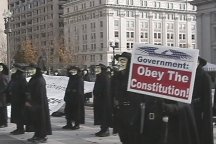 Institutionalize vigilance with the "We The People Congress" as Bob Schulz addresses the Right to Petition.
Work with Hagan Smith and the Constitution Party of Pennsylvania to restore the Council of Censors in Pennsylvania.
Wednesday, March 07, 2007
The Attorney General Responds
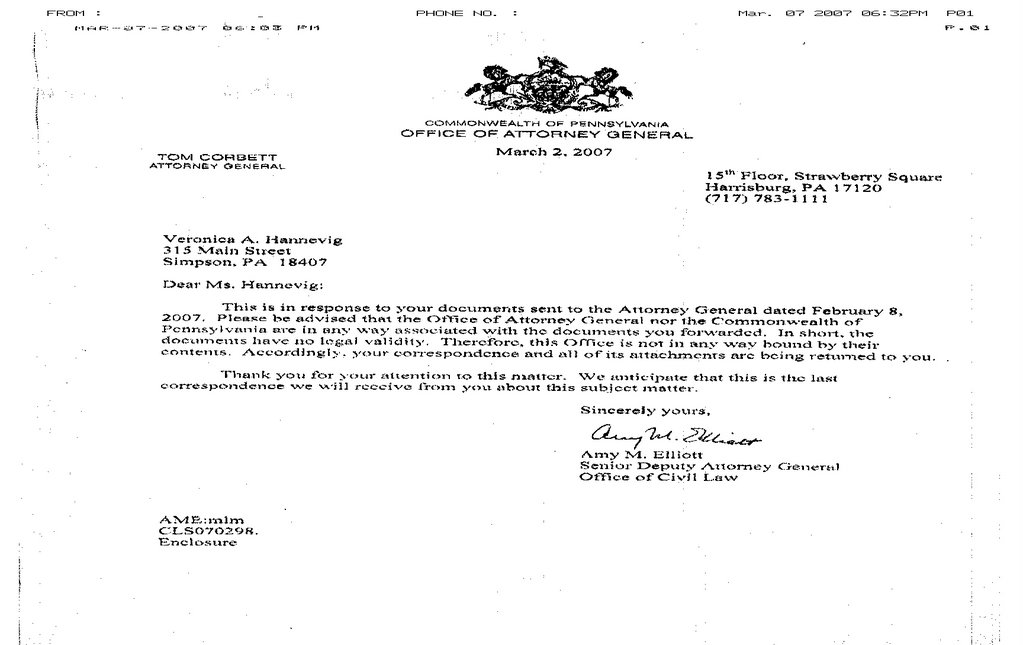
Here is the response from the Office of Attorney General to my Petition For Review whereby I brought on appeal Pennsylvania and United States Constitutional questions regarding jurisdiction, title, agency, identity and ownership.
Click here to read the duties and responsibilities of the elected Attorney General. The Attorney General's duties and responsibilities were established by the Commonwealth Attorneys Act of 1980.
Thursday, September 14, 2006
Judicial Conduct Board Complaint (Updated 12/13/08)
On August 22nd, while present in the court of common pleas for that appeal, Judge Vito Geroulo announced "Commonwealth vs. Hannevig." To better understand what I was going to be dealing with before I entered his bar, I attempted to clarify with him which case was being tried; the one from the magistrate (wherein I am a "defendant"), or my appeal (where I am a "plaintiff")? The judge, Vito Geroulo, told me I was "wasting" his time.
I asked again, explaining that this appeal was brought to the court as a "Claim of Conusance"/"Claim of Cognizance" wherein it was up to the courts to resolve the controversy, and I wanted to be prepared to enter the court based on how I was being perceived.
Instead of replying to my question, Judge Geroulo said I was in "contempt" and signaled the Sheriff's deputies.
I was handcuffed and taken to a room where I was searched and put in a holding cell. About 5 - 10 minutes later, I was put in leg irons and re-handcuffed, this time, with the belt to hold my hands firmly against my waist and taken back into court for regurgitation of the issues that brought me there from the magistrate's court for the appeal!
Judge Geroulo said I could appeal. I reminded him that the appeal was before him and had not yet been heard. Judge Geroulo refused to hear the enclosed appeal. Here's what's been happening:
1. The Numbers for the Thirteen (13) Dockets originally in controversy; TR-0000155-06, TR-0000158-06, TR-0000162-06, TR-0000160-06, TR-0000157-06, TR-0000164-06, TR-0000165-06, TR-0000166-06, TR-0000159-06, TR-0000161-06, TR-0000163-06, TR-0000153-06, and TR-0000154-06, were, upon submission of a “Notice of Appeal from Summary Criminal Conviction,” given Docket Numbers; CP-35-SA-0000064-2006, CP-35-SA-0000065-2006, CP-35-SA-0000066-2006, CP-35-SA-0000067-2006, CP-35-SA-0000068-2006, CP-35-SA-0000069-2006, CP-35-SA-0000070-2006, CP-35-SA-0000071-2006, CP-35-SA-0000072-2006, CP-35-SA-0000073-2006, CP-35-SA-0000074-2006, CP-35-SA-0000075-2006, and CP-35-SA-0000076-2006.
2. Janet L. Dolan, Director Bureau of Driver Licensing, failed to respond to a May 22, 2006, Certified Mail #70051820000818337944, wherein Fiduciary, Dolan, was asked to provide the “wet ink” “valid” documentation of my contractual obligations with the Commonwealth of Pennsylvania, Department of Transportation, Bureau of Driver Licensing that would substantiate the Commonwealth's claim that I had a current “driving record” upon which her actions could be taken.
3. On 7/10/06, knowing the disposition of the 1987 Toyota Camry that was impounded by Officer James Reed on February 1, 2006, was on appeal and the title in controversy, and that he did not rebut my full acceptance of his “Not Guilty” plea, Magistrate Sean P. McGraw participated with City of Carbondale Police Officer Joseph A Demchak, Badge #101, in the issuance, and conviction of Docket No.: TR-0000860-06. A conviction that was predicated on Citation No.: B3206329-0 with the remark in block “62;” “Title request by G & G Towing.”
4. Lackawanna County, District Attorney, Andrew J. Jarbola, III, on August 4, 2006, implied in his letter regarding my appeal that he was a judge when he stated in that letter that the hearing for my appeal would be in his office on August 22, 2006 at 9:30 a.m. and that my failure to appear may result in automatic dismissal of my case by the Court. District Attorney, Jarbola, failed to respond to my August 11, 2006 faxed (570-963-6725) request that he provide to me proof of his implied claim that he qualified as a judge and his court is the court of common pleas for Lackawanna County.
5. Judge, Vito Geroulo, in the court of common pleas, Lackawanna County, on August 22, 2006, had employees of the Sheriff’s Department shackle my wrists and ankles before taking me before the bar to try me again for the “Not Guilty” charges I had already fully accepted.
6. Judge, Vito Geroulo did not allow me to present my petition for review in his court for governmental redress of grievances under the Constitution and Laws of these united States of America and under the Constitutional Charter of the Commonwealth of Pennsylvania.
Judge Geroulo’s behavior in court implied misdemeanor offenses consistent with 18 Pa.C.S.A. §2902(2); and the issue of title remains in controversy.
The Judicial Conduct Board's response is for you, the court
of public opinion, to contemplate.


Click HERE for the gist of this, and other, controversies.
Supreme Court Disciplinary Board Complaint (Updated 12/13/08)
E. STATEMENT OF COMPLAINT: (Note: Attach as many additional pages as necessary to fully set forth all of the relevant facts and circumstances surrounding your complaint).
1. On March 16, 2006 Magistrate Sean P. McGraw, Esquire, District Court 45-3-03, Carbondale, Lackawanna County, in response to my February 13, 2006 ex relatione, quo warranto opportunity to privately resolve a justiciable claim, claim of conusance/claim of cognizance, entered a “NOT GUILTY” plea and the sum of “$.00” for each of thirteen (13) criminal convictions pursuant to the Pennsylvania Title 75 Motor Vehicle code.
2. On April 17, 2006 each of the thirteen (13) Dockets; TR-0000155-06, TR-0000158-06, TR-0000162-06, TR-0000160-06, TR-0000157-06, TR-0000164-06, TR-0000165-06, TR-0000166-06, TR-0000159-06, TR-0000161-06, TR-0000163-06, TR-0000153-06, and TR-0000154-06, were fully accepted and returned for value with the additional request that the title be released and the account closed.
3. On May 1, 2006, contrary to the jurisdictional facts and evidence presented by City of Carbondale Officers Reed and Fofi, Magistrate Sean P. McGraw, Esquire presumed jurisdiction, repudiated his not guilty pleas, and convicted me of twelve of the thirteen aforementioned dockets.
4. On May 8, 2006 I motioned the court for IFP status (enclosed) and filed with the court of common pleas, Lackawanna County, to appeal Magistrate McGraw’s breach of duty and his twelve (12) criminal convictions pursuant to the Pennsylvania Title 75 Motor Vehicle code (enclosed).
5. The Numbers for the Thirteen (13) Dockets originally in controversy; TR-0000155-06, TR-0000158-06, TR-0000162-06, TR-0000160-06, TR-0000157-06, TR-0000164-06, TR-0000165-06, TR-0000166-06, TR-0000159-06, TR-0000161-06, TR-0000163-06, TR-0000153-06, and TR-0000154-06, were, upon submission of a “Notice of Appeal from Summary Criminal Conviction,” given Docket Numbers; CP-35-SA-0000064-2006, CP-35-SA-0000065-2006, CP-35-SA-0000066-2006, CP-35-SA-0000067-2006, CP-35-SA-0000068-2006, CP-35-SA-0000069-2006, CP-35-SA-0000070-2006, CP-35-SA-0000071-2006, CP-35-SA-0000072-2006, CP-35-SA-0000073-2006, CP-35-SA-0000074-2006, CP-35-SA-0000075-2006, and CP-35-SA-0000076-2006. Submitted to each Docket was a copy of the acceptance of Magistrate McGraw, Esquire’s “not guilty” plea.
6. Janet L. Dolan, Director Bureau of Driver Licensing, failed to respond to a May 22, 2006, Certified Mail #70051820000818337944, wherein Fiduciary, Dolan, was asked to provide the “wet ink” “valid” documentation of my contractual obligations with the Commonwealth of Pennsylvania, Department of Transportation, Bureau of Driver Licensing that would substantiate the Commonwealth's claim that I had a current “driving record” upon which her actions could be taken. (Copies of these two correspondences are enclosed.)
7. On 7/10/06, knowing the disposition of the 1987 Toyota Camry that was impounded by Officer James Reed on February 1, 2006, was on appeal and the title in controversy, and that he did not rebut my full acceptance of his “Not Guilty” plea, Magistrate Sean P. McGraw participated with City of Carbondale Police Officer Joseph A Demchak, Badge #101, in the issuance, and conviction of Docket No.: TR-0000860-06. A conviction that was predicated on Citation No.: B3206329-0 with the remark in block “62;” “Title request by G & G Towing.” (Thirteen pages attached.)
8. On August 4, 2006, Lackawanna County, District Attorney, Andrew J. Jarbola, III, implied in his letter regarding my appeal that he was a judge, and that his office was the “one court of common pleas” in the Lackawanna County judicial district when he stated in that letter that the hearing for my appeal would be in his office on August 22, 2006 at 9:30 a.m. and that my failure to appear may result in automatic dismissal of my case by the Court. (One page attached.)
9. District Attorney, Jarbola, failed to respond to my August 11, 2006 faxed (570-963-6725) request that he provide to me proof; that he qualified as a judge, that his court is the “one” court of common pleas for Lackawanna County, and that there were (in my case) “exceptions” that would preclude my appeal from being heard by a bona fide court of common pleas judge. (Two pages attached.)
10. On August 22, 2006 the court of common pleas Judge, Vito Geroulo did not allow me to present my appeal. (Eighteen page appeal; claim of conusance/claim of cognizance Petition for Review attached.)
11. On August 22, 2006, without hearing my appeal, court of common pleas Judge, Vito Geroulo, signed Lackawanna County District Attorney Andrew J. Jarbola, Esquire’s, “ORDERED and DECREED” guilt and stated fines for eight (8) of the thirteen (13) repudiated citations.
12. Attorney Andrew J. Jarbola, Esquire’s August 4, 2006 letter to me, and his subsequent August 22, 2006 “ORDER” “IN THE COURT OF COMMON PLEAS OF LACKAWANNA COUNTY”, suggests a treasonable collusive action that precluded my right to appeal the substantive issues that remain in controversy: First and foremost among those substantive issues are fundamental matters of jurisdiction and title. (“ORDER” attached.)
13. District Attorney Andrew J. Jarbola III, Esquire’s actions clearly exceeded the limits of his canons; i.e., “Code of Professional Responsibility,” and in so doing Attorney Jarbola perpetrated fraud upon Judge Vito Geroulo, and the court with conduct so egregious that it interfered with the task of fair and impartial adjudication of the substantive issues brought before it on appeal. District Attorney Jarbola’s violations in this instance is worthy of full investigation by the Disciplinary Board of the Supreme Court of Pennsylvania for such disciplinary actions they shall deem advisable.
To the right is the letter from District Attorney Jarbola's office.


Click HERE for an overview of this, and other, controversies.
Sunday, September 10, 2006
Government Is Foreclosed from Parity with Real People
Government Is Foreclosed from Parity with Real People
Supreme Court of the United States 1795
"Inasmuch as every government is an artificial person, an abstraction, and a creature of the mind only, a government can interface only with other artificial persons. The imaginary, having neither actuality nor substance, is foreclosed from creating and attaining parity with the tangible. The legal manifestation of this is that no government, as well as any law, agency, aspect, court, etc. can concern itself with anything other than corporate, artificial persons and the contracts between them." S.C.R. 1795, Penhallow v. Doane's Administraters (3 U.S. 54; 1 L.Ed . 57; 3 Dall. 54), Supreme Court of the United States
To understand fully the 4th, 5th, 6th, 7th, 8th, 9th, and 10th Articles of Amendment to the Constitution for the united States of America, one might study for hours and hours the case of, U.S. v James Daniel Good Real Property, 114 S. Ct. 492, 496m 505D (1993).
It is now well settled that there is no judicial remedy in favor of an individual against a state to compel the performance of a contract, though it is settled that a state can pass no law impairing the obligation of a contract once made (18 Murry v Charleston, 96 U.S. 432 is an instructive case on this subject).
"There is no such thing as power of inherent Sovereignty in the government of the United States. In this country sovereignty resides in the People, and Congress can exercise no power which they have not, by their Constitution entrusted to it; All else is withheld." Jillird v. Greenman, 110 U.S. 421.
"As in the case of illegal arrests, the officer is bound to know these fundamental rights and priveliges, and must keep within the law at his peril." Thiede v. Town of Scandia Valley, 217 Minn. 218, 231 14N.W. (2d) 400 (1944)
"The innocent individual who is harmed by an abuse of governmental authority is assured that he will be compensated for his injury." Owens v. City of Independence,
100 S.Ct 1398 (1980)
Failure to obey the command of a police officer constitutes a traditional form of breach of the peace. Obviously, however, one cannot be punished for failing to obey the command of an officer if the command itself is violative of the constitution." Wright v. Georgia 373 US 284
"There can be no sanction or penalty imposed upon one because of his exercise of Constitutional rights." Sherar v. Cullen 481 F. 946
A plaintiff who seeks damages for violation of constitutional or statutory rights may overcome the defendant official's qualified immunity only by showing that those rights were clearly established at the time of the conduct at issue." Davis v. Scherer, 82 L.Ed.2d 139,151.
"An unconstitutional act is not law; it confers no rights; it imposes no duties; affords no protection; it creates no office; it is in legal contemplation, as inoperative as though it had never been passed." -- Norton vs. Shelby County,
118, US 425 p. 442
--
"It is not the function of our government to keep the Citizen from falling into error; it is the function of the Citizen to keep the government from falling into error." American Communications Ass'n v. Douds, 339 U.S. 382, 442.
Saturday, January 10, 2004
President Bush's Doublespeak Speech on Immigration
On Wednesday,January 7, 2004 I listened with unbelief at what I was hearing in portions of President Bush's doublespeak speech on immigration. On the 8th, I had the opportunity to read his speech as recorded at http://www.WorldNetDaily.com and I have embolden my thoughts below. As I interpreted what I heard, it seemed as if President Bush was proudly saying that the United States will become the modern day Slave Broker for global corporations. In reading the doublespeak, it is apparent, to me, that that is his goal - UNLESS he is stopped by congress.
Find below, portions of President Bush's doublespeak speech with the troublesome legal jurisdictional and other key words highlighted. I have occasionally interspersed "()" for clarification and questions.
----------------------------------------
. . .
"Second, new immigration laws should serve the economic needs of our country. If an American employer is offering a job that American citizens are not willing to take, we ought to welcome into our country a person who will fill that job.
"Third, . . . .
"Fourth, new laws should provide incentives for temporary foreign workers to return permanently to their home countries after their period of work in the United States has expired."
Today I ask the Congress to join me in passing new immigration laws that reflect these principles that meet America's economic needs and live up to our highest ideals. (APPLAUSE)
I propose a new temporary worker program that will match willing foreign workers with willing American employers when no Americans can be found to fill the jobs.
(Isn't this what the slave traders did? Are American's not filling the jobs because they are forced to relinquish their American citizenship for United States citizenship?)
This program will offer legal status as temporary workers to the millions of undocumented men and women now employed in the United States and to those in foreign countries who seek to participate in the program and have been offered employment here.
This new system should be clear and efficient so employers are able to find workers quickly and simply.
(Eye scan, fingerprints, credit reports, etc. that can then be marketed to "foreign" corporations/countries for a monetary profit.)
All who participate in the temporary worker program must have a job or, if not living in the United States, a job offer. The legal status granted by this program will last three years and will be renewable, but it will have an end. Participants who do not remain employed, who do not follow the rules of the program or who break a law will not be eligible for continued participation and will be required to return to their home.
(What happens to the "American" man or woman who refuses to take on the "legal status" that's granted to those who "live in the United States"?)
Under my proposal, employers have key responsibilities. Employers who extend job offers must first make every reasonable effort to find an American worker for the job at hand. Our government will develop a quick and simple system for employers to search for American workers.
(This should make every American shudder!)
Employers must not hire undocumented aliens or temporary workers whose legal status has expired. They must report to the government the temporary workers they hire and who leave their employ so that we can keep track of people in the program and better enforce our immigration laws. There must be strong workplace enforcement with tough penalties for anyone -- for any employer violating these laws.
Undocumented workers now here will be required to pay a one-time fee to register for the temporary worker program. Those who seek to join the program from abroad and have complied with our immigration laws will not have to pay any fee.
All participants will be issued a temporary worker card that will allow them to travel back and forth between their home and the United States without fear of being denied re-entry into our country. (APPLAUSE)
(This too! "Our county"; Who's country?)
This program expects temporary workers to return permanently to their home countries after their period of work in the United States has expired, and there should be financial incentives for them to do so.
I will work with foreign governments on a plan to give temporary workers credit when they enter their own nation's retirement system for the time they have worked in America.
(What's the Constitutional definition of "foreign" as it applies to the "United States", "America", and the "several states"?)
I also support making it easier for temporary workers to contribute a portion of their earnings to tax-preferred savings accounts, money they can collect as they return to their native countries. After all, in many of these countries a small nest egg is what is necessary to start their own business or buy some land for their family.
Some temporary workers will make the decision to pursue American citizenship. Those who make this choice will be allowed to apply in the normal way. They will not be given unfair advantage over people who have followed legal procedures from the start.
I opposed amnesty, placing undocumented workers on the automatic path to citizenship. Granting amnesty encourages the violation of our laws and perpetuates illegal immigration.
(Again I ask; Who's laws?)
America's a welcoming country, but citizenship must not be the automatic reward for violating the laws of America. (APPLAUSE)
(I agree! Does this apply to members of the United States Congress, its Judicial system, and our state and local representatives who collude with them?)
. . .
In the process of immigration reform, we must also set high expectations for what new citizens should know. An understanding of what it means to be an American is not a formality in the naturalization process, it is essential to full participation in our democracy.
(Who comprises the "our"? In America, our Constitution "guarantees" to an "endowed" "people" a "republican form of government".)
My administration will examine the standard of knowledge in the current citizenship test. We must ensure that new citizens know not only the facts of our history, but the ideals that have shaped our history.
(Again; Who comprises "We" and "our"? Why would a People who have an "endowment" from their "Creator", He who formed the earth and all that is in it, want to embrace the "ideals that have shaped" their "history" and leave a jurisdiction of not more than 613 laws for the legal entanglement of a commercial entity called the United States and their whimsical legislation?)
Every citizen of America has an obligation to learn the values that make us one nation: liberty and civic responsibility, equality under God, tolerance for others.
("Civic responsibility". Does this mean that after the corporate Master has been served for the legislated amount of time the US citizen will now be required to volunteer for some NGO?)
. . .
In a few days I will go to Mexico for the Special Summit of the Americas, where we will discuss ways to advance free trade, and to fight corruption, and encourage the reforms that lead to prosperity. Real growth and real hope in the nations of our hemisphere will lessen the flow of new immigrants to America when more citizens of other countries are able to achieve their dreams at their own home. (APPLAUSE)
(Reforms like direct deposits and paper less money that will increase profits for the promoters of this plan?)
------------------------------------------------------
Here is what I understand to be fact; and how President Bush's speech fits into the larger plan of those who are identified as the owners of the Federal Reserve and International Monetary Fund.
What I understand to be fact:
If a man is paid one $10.00 bill for his labor.
The federal tax collected by the Internal Revenue on behalf of the owners of the Federal Reserve is approximately 20%, or $2.00.
The $10.00 "bill" cost the Federal Reserve approximately 4.2 cents to print - regardless of the denomination.
Although the laboring man perceives his earnings to be $10.00, the actual breakdown appears to be that:
The owners of the Federal Reserve profit $9.958 for printing the $10.00 bill, plus $2.00 from the Federal Tax collected by agents of the IRS.
As I see it, approximately $11.96 is the laboring man's debt to the owners of the Federal Reserve for each $10.00 of his labor.
(Thanks to a reporter at the Wall Street Journal who recently referred me to a web site I've corrected my initial understanding that the cost of printing a bill of any denomination was 7 cents was, in fact, 4.2 cents! I asked him to let his readers know what is the nature of the collateral that is being held by the securities and exchange that allows the Federal Reserve to continue to print the money rather than Congress.)
And, here is my interpretation of what is happening.
Since our government representatives are either unable, or unwilling, to answer questions regarding the legality of the income tax and people are getting wise to the fact that there is no avenue for "redress", people are, therefore, saying "no answers, no taxes!"
What President Bush's speech sounded like to me is that this issuance of "status" will dupe the immigrant worker of today into a 'global citizenship', much like the European immigrants, and African's were duped into becoming United States citizens within the 13th Amendment, then the 14th Amendment citizens who were afterward born into their parents "voluntary servitude". After that came the 19th Amendment "sex" citizen who desired the 'benefit and privilege' that came with this new found avenue of dependency upon the (at that time) wealthy American nation, and their People.
For the Article 1, Section 8, Corporate/Commercial United States, this all appears to be quite legal; seeing that that would make the President the CEO of that Corporation. However, for an American who understands that they've been "endowed with unalienable Rights" as set forth in the Declaration of Independence - and other founding documents - and protected by the Constitution of 1791 (The Law of the Land), and several of our state Constitutions, the recent decisions/decrees by this president and his 17th Amendment congress is abhorrent and unlawful. As highlighted above, CEO Bush was very careful with his doublespeak to create a legal net of entrapment for any worker who does not acquiesce to his vision of a global plantation that brings profits to its owners.
Here in northeast Pennsylvania Commonwealth Representative, Jim Wansacz, and Congressman, Don Sherwood, are both on the letterhead as Board of Directors to the United Nations of Northeast Pennsylvania (along with former Mayor Wenzel of Scranton, and others from the corporate banks and institutions of higher education).
I suspect that this decree will fit rather well into a soon to be announced Global Constitution wherein it will be revealed that NGO's have quietly and incrementally taken over the administration of our governments, even into its most local levels.
Today, in my mind, is a day of "weeping and gnashing of teeth".
Here is a copy of President Bush's speech as it appeared in World Net Daily.
Wednesday, January 7, 2004
COMING TO AMERICA
Text of Bush immigration speech
President outlines plan to give illegals legal status
Posted: January 7, 2004
3:48 p.m. Eastern
PRESIDENT GEORGE W. BUSH: Thank you all for coming. Thanks for coming. Thanks for the warm welcome. Thanks for joining me as I make this important announcement, an announcement that I believe will make America a more compassionate, more humane and stronger country.
I appreciate members of my Cabinet who have joined me today, starting with our secretary of state, Colin Powell. (APPLAUSE)
I'm honored that our attorney general, John Ashcroft, has joined us. (APPLAUSE)
Secretary of Commerce Don Evans. (APPLAUSE)
Secretary Tom Ridge of the Department of Homeland Security, I'm honored you're here.
El Embajador de Mexico Tony Garza. (APPLAUSE)
I thank all the other members of my administration who joined us today. I appreciate the Members of Congress who've taken time to come, Senator Larry Craig, Congressman Chris Cannon and Congressman Jeff Flake.
I'm honored you all have joined us. Thank you for coming.
I appreciate the members of citizen groups who've joined us today, chairman of the Hispanic Alliance For Progress, Mani Luhan (ph); Gil Moreno, the president and CEO of the Association for the Advancement of Mexican-Americans; Roberta Deposada, the president of the Latino Coalition; and Hector Flores, the president of LULAC.
Thank you all for joining us. (APPLAUSE)
Many of you here today are Americans by choice, and you have followed in the path of millions. And over the generations, we have received energetic, ambitious, optimistic people from every part of the world.
By tradition and conviction, our country is a welcoming society. America is a stronger and better nation because of the hard work and the faith and the entrepreneurial spirit of immigrants.
Every generation of immigrants has reaffirmed the wisdom of remaining open to the talents and dreams of the world. And every generation of immigrants has reaffirmed our ability to assimilate newcomers, which is one of the defining strengths of America.
During one great period of immigration, between 1891 and 1920, our nation received some 18 million men, women and children from other nations.
The hard work of these immigrants helped make our economy the largest in the world. The children of immigrants put on the uniform and helped to liberate the lands of their ancestors.
One of the primary reasons America became a great power in the 20th century is because we welcomed the talent and the character and the patriotism of immigrant families.
The contributions of immigrants to America continue. About 14 percent of our nation's civilian workforce is foreign born. Most begin their working lives in America by taking hard jobs and clocking long hours in important industries. Many immigrants also start businesses, taking the familiar path from hired labor to ownership.
As a Texan, I have known many immigrant families, mainly from Mexico, and I've seen what they add to our country. They bring to America the values of faith in God, love of family, hard work, and self-reliance; the values that made us a great nation to begin with.
We've all seen those values in action through the service and sacrifice of more than 35,000 foreign-born men and women currently on active duty in the United States military. One of them is Master Gunnery Sergeant Guadalupe Denogean, an immigrant from Mexico, who has served in the Marine Corps for 25 years and counting.
Last year, I was honored and proud to witness Sergeant Denogean take the oath of citizenship in a hospital where he was recovering from wounds he received in Iraq.
I'm honored to be his commander in chief. I'm proud to call him "fellow American." (APPLAUSE)
As a nation that values immigration and depends on immigration, we should have immigration laws that work and make us proud. Yet today we do not.
Instead we see many employers turning to the illegal labor market, we see millions of hardworking men and women condemned to fear and insecurity in a massive, undocumented economy.
Illegal entry across our borders makes more difficult the urgent task of securing the homeland. The system is not working. Our nation needs an immigration system that serves the American economy and reflects the American dream.
Reform must begin by confronting a basic fact of life and economics: Some of the jobs being generated in America's growing economy are jobs American citizens are not filling.
Yet these jobs represent a tremendous opportunity for workers from abroad who want to work and to fulfill their duties as a husband or a wife, a son or a daughter.
Their search for a better life is one of the most basic desires of human beings. Many undocumented workers have walked mile after mile, through the heat of the day and the cold of the night. Some have risked their lives in dangerous desert border crossings or entrusted their lives to the brutal rings of heartless human smugglers.
Workers who seek only to earn a living end up in the shadows of American life, fearful, often abused and exploited.
When they're victimized by crimes they're afraid to call the police or seek recourse in the legal system. They are cut off from their families far away, fearing if they leave our country to visit relatives back home they might never be able to return to their jobs.
The situation I described is wrong. It is not the American way.
Out of common sense and fairness, our laws should allow willing workers to enter our country and fill jobs that Americans are not filling. (APPLAUSE)
We must make our immigration laws more rational and more humane. And I believe we can do so without jeopardizing the livelihoods of American citizens.
Our reforms should be guided by a few basic principles.
First, America must control its borders. Following the attacks of September the 11th, 2001, this duty of the federal government has become even more urgent, and we're fulfilling that duty.
For the first time in our history we have consolidated all border agencies under one roof, to make sure they share information and the work is more effective.
We're matching all visa applicants against an expanded screening list to identify terrorists and criminals and immigration violators.
This month we have become using advanced technology to better record and track aliens who enter our country and to make sure they leave as scheduled.
We have deployed new gamma and X-ray systems to scan cargo and containers and shipments at ports of entry to America.
We have significantly expanded the Border Patrol with more than 1,000 new agents on the borders and 40 percent greater funding over the last two years. We're working closely with the Canadian and Mexican governments to increase border security.
America is acting on a basic belief: Our borders should be open to legal travel and honest trade; our borders should be shut and barred tight to criminals, to drug traders, drug traffickers and to criminals and to terrorists.
Second, new immigration laws should serve the economic needs of our country. If an American employer is offering a job that American citizens are not willing to take, we ought to welcome into our country a person who will fill that job.
Third, we should not give unfair rewards to illegal immigrants in the citizenship process or disadvantage those who came here lawfully or hope to do so.
Fourth, new laws should provide incentives for temporary foreign workers to return permanently to their home countries after their period of work in the United States has expired.
Today I ask the Congress to join me in passing new immigration laws that reflect these principles that meet America's economic needs and live up to our highest ideals. (APPLAUSE)
I propose a new temporary worker program that will match willing foreign workers with willing American employers when no Americans can be found to fill the jobs.
This program will offer legal status as temporary workers to the millions of undocumented men and women now employed in the United States and to those in foreign countries who seek to participate in the program and have been offered employment here.
This new system should be clear and efficient so employers are able to find workers quickly and simply.
All who participate in the temporary worker program must have a job or, if not living in the United States, a job offer. The legal status granted by this program will last three years and will be renewable, but it will have an end. Participants who do not remain employed, who do not follow the rules of the program or who break a law will not be eligible for continued participation and will be required to return to their home.
Under my proposal, employers have key responsibilities. Employers who extend job offers must first make every reasonable effort to find an American worker for the job at hand. Our government will develop a quick and simple system for employers to search for American workers.
Employers must not hire undocumented aliens or temporary workers whose legal status has expired. They must report to the government the temporary workers they hire and who leave their employ so that we can keep track of people in the program and better enforce our immigration laws. There must be strong workplace enforcement with tough penalties for anyone -- for any employer violating these laws.
Undocumented workers now here will be required to pay a one-time fee to register for the temporary worker program. Those who seek to join the program from abroad and have complied with our immigration laws will not have to pay any fee.
All participants will be issued a temporary worker card that will allow them to travel back and forth between their home and the United States without fear of being denied re-entry into our country. (APPLAUSE)
This program expects temporary workers to return permanently to their home countries after their period of work in the United States has expired, and there should be financial incentives for them to do so.
I will work with foreign governments on a plan to give temporary workers credit when they enter their own nation's retirement system for the time they have worked in America.
I also support making it easier for temporary workers to contribute a portion of their earnings to tax-preferred savings accounts, money they can collect as they return to their native countries. After all, in many of these countries a small nest egg is what is necessary to start their own business or buy some land for their family.
Some temporary workers will make the decision to pursue American citizenship. Those who make this choice will be allowed to apply in the normal way. They will not be given unfair advantage over people who have followed legal procedures from the start.
I opposed amnesty, placing undocumented workers on the automatic path to citizenship. Granting amnesty encourages the violation of our laws and perpetuates illegal immigration.
America's a welcoming country, but citizenship must not be the automatic reward for violating the laws of America. (APPLAUSE)
The citizenship line, however, is too long, and our current limits on legal immigration are too low.
My administration will work with the Congress to increase the annual number of green cards that can lead to citizenship.
Those willing to take the difficult path of citizenship, the path of work and patience and assimilation, should be welcome in America, like generations of immigrants before them. (APPLAUSE)
In the process of immigration reform, we must also set high expectations for what new citizens should know. An understanding of what it means to be an American is not a formality in the naturalization process, it is essential to full participation in our democracy.
My administration will examine the standard of knowledge in the current citizenship test. We must ensure that new citizens know not only the facts of our history, but the ideals that have shaped our history.
Every citizen of America has an obligation to learn the values that make us one nation: liberty and civic responsibility, equality under God, tolerance for others.
This new temporary worker program will bring more than economic benefits to America. Our homeland will be more secure when we can better account for those who enter our country.
Instead of the current situation, in which millions of people are unknown, unknown to the law, law enforcement will face fewer problems with undocumented workers, and will be better able to focus on the true threats to our nation from criminals and terrorists.
And when temporary workers can travel legally and freely, there will be more efficient management of our borders and more effective enforcement against those who pose a true threat to our country. (APPLAUSE)
This new system will be more compassionate. Decent, hardworking people will now be protected by labor laws, with the right to change jobs, earn fair wages and enjoy the same working conditions that the law requires for American workers.
Temporary workers will be able to establish their identities by obtaining the legal documents that we all take for granted. And they will be able to talk openly to authorities to report crimes when they're harmed without the fear of being deported. (APPLAUSE)
The best way in the long run to reduce the pressures that create illegal immigration in the first place is to expand economic opportunity among the countries in our neighborhood. Real growth and real hope in the nations of our hemisphere will lessen the flow of new immigrants
In a few days I will go to Mexico for the Special Summit of the Americas, where we will discuss ways to advance free trade, and to fight corruption, and encourage the reforms that lead to prosperity. Real growth and real hope in the nations of our hemisphere will lessen the flow of new immigrants to America when more citizens of other countries are able to achieve their dreams at their own home. (APPLAUSE)
Yet our country has always benefited from the dreams that others have brought here. By working hard for a better life immigrants contribute to the life of our nation.
The temporary worker program I am proposing today represents the best tradition of our society, a society that honors the law and welcomes the newcomer.
This plan will help return order and fairness to our immigration system, and in so doing we will honor our values by showing our respect for those who work hard and share in the ideals of America.
May God bless you all.
Archives
May 2003 June 2003 January 2004 September 2006 March 2007 May 2007 July 2007 November 2007 May 2009 September 2009 October 2009 April 2010 March 2011 June 2013
